When buying an apartment, one of the first things a homebuyer usually checks is the size of the property. However, the area mentioned in a real estate brochure may not always represent the actual usable space inside the apartment. Terms such as carpet area, built-up area, and super built-up area are commonly used to describe property sizes, and understanding the differences is essential before making a purchase decision.
For example, an apartment advertised as 2,000 sq. ft. may not offer 2,000 sq. ft. of usable indoor space. The advertised figure could include wall thickness, balconies, and a proportionate share of common areas, depending on the area measurement being used.
This distinction becomes particularly important when comparing residential properties in Gurgaon, where developers offer a wide range of apartments, from compact 2 BHK homes to spacious 3, 4 and 5 BHK luxury residences.
So, what is the difference between carpet area, built-up area, and super built-up area? Which measurement should buyers consider while purchasing a flat? And how does RERA regulate the disclosure of apartment sizes?
Let's understand each term with simple examples.
What Is Carpet Area?

Carpet area is the net usable floor area of an apartment, excluding external walls, service shafts, exclusive balconies, verandahs and open terraces, while including the area covered by internal partition walls.
In simple terms, carpet area represents the usable space within an apartment where residents can arrange furniture, move around and carry out their daily activities.
It generally includes:
- Living and dining areas
- Bedrooms
- Kitchen
- Bathrooms and toilets
- Internal passages
- Other usable indoor spaces
- Area occupied by internal partition walls
However, under the definition provided by Section 2(k) of the Real Estate (Regulation and Development) Act, 2016, carpet area excludes external walls, service shafts, exclusive balcony or verandah areas and exclusive open terrace areas.
For example, if an apartment has a RERA carpet area of 1,000 sq. ft., that figure includes the internal usable floor area and internal partition walls, but excludes the specified external and exclusive outdoor areas.
What Is RERA Carpet Area?
RERA carpet area is the legally defined measurement of an apartment's net usable floor area under the RERA Act, 2016.
Before RERA, there was considerable variation in how developers described apartment sizes. The introduction of a standard definition helped bring greater transparency to property transactions.
Under Section 2(k), the following are excluded from carpet area:
- External walls
- Service shafts
- Exclusive balconies
- Exclusive verandahs
- Exclusive open terraces
Internal partition walls are included in the calculation.
This makes RERA carpet area an important measurement for buyers when comparing the actual size of different apartments.
What Is Built-Up Area?
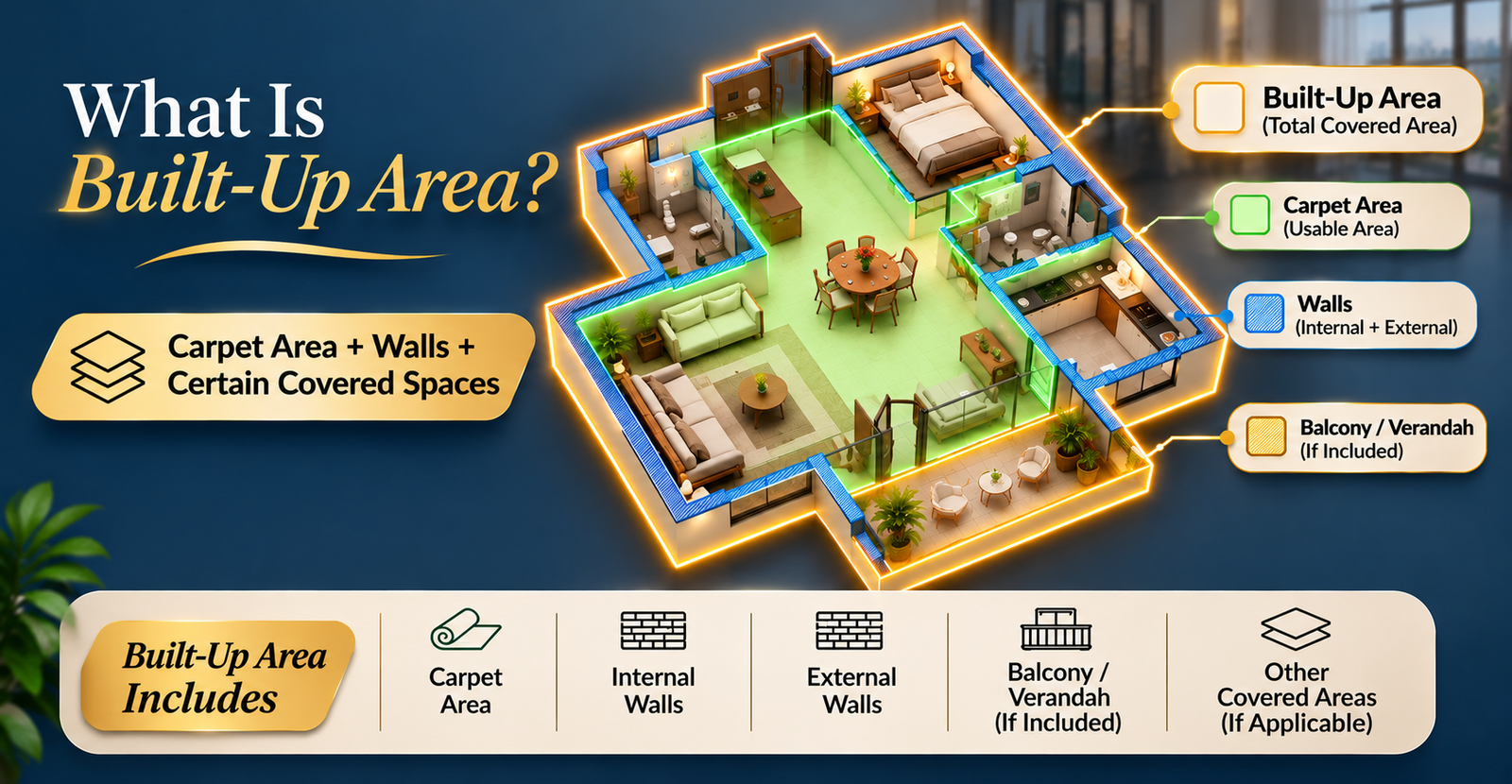
Built-up area generally refers to the carpet area of an apartment along with the area occupied by its walls and certain additional covered spaces, depending on the measurement convention used.
Unlike carpet area, the term built-up area does not have a separate standard definition under the central RERA Act. Its exact components should therefore be checked in the project documents, agreement or area statement.
Built-up area commonly includes:
- Carpet area
- Thickness of internal walls
- Thickness of external walls
- Balcony or verandah areas, where included in the stated measurement
- Other covered areas, where applicable under the relevant calculation method
For example, if an apartment has a carpet area of 1,000 sq. ft. and the area attributed to walls and other included covered spaces is 150 sq. ft., its built-up area may be stated as 1,150 sq. ft.
The exact difference depends on the apartment layout, wall thickness and what the developer or seller includes in the calculation.
Example of Built-Up Area
Consider an apartment with the following illustrative measurements:
| Component | Area |
| Carpet area | 1,000 sq. ft. |
| Additional wall and included covered area | 150 sq. ft. |
| Built-up area | 1,150 sq. ft. |
This means the built-up area is larger than the carpet area because it accounts for additional covered portions of the apartment.
What Is Super Built-Up Area?
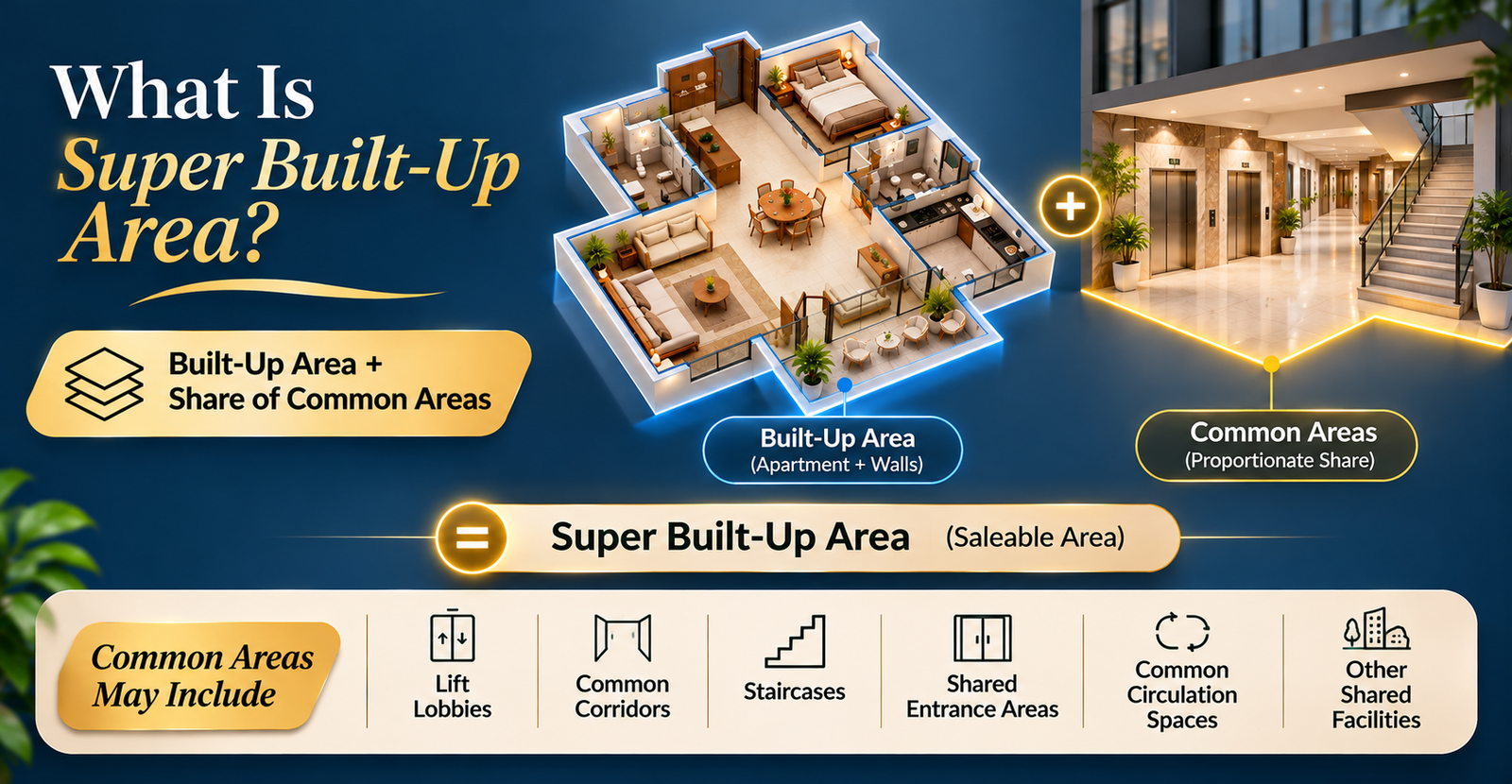
Super built-up area generally refers to the built-up area of an apartment plus its proportionate share of certain common areas within a residential building or complex.
It is also commonly referred to as the saleable area in traditional real estate terminology.
Common areas that may be considered in a super built-up area calculation include:
- Lift lobbies
- Common corridors
- Staircases
- Shared entrance areas
- Common circulation spaces
- Other shared facilities, depending on the applicable calculation and agreement
Some older agreements and market practices may also refer to additional common facilities. However, there is no single universal formula for super built-up area under the central RERA Act.
For example, if an apartment has a built-up area of 1,150 sq. ft. and an allocated share of common areas amounting to 250 sq. ft., its super built-up area would be 1,400 sq. ft.
The additional 250 sq. ft. does not mean the apartment has gained 250 sq. ft. of private indoor space. It represents the proportionate common-area component used in that particular calculation.
Example of Super Built-Up Area
| Component | Area |
| Built-up area | 1,150 sq. ft. |
| Proportionate common-area allocation | 250 sq. ft. |
| Super built-up area | 1,400 sq. ft. |
This is why the super built-up area is generally larger than the built-up area and carpet area.
Carpet Area vs Built-Up Area vs Super Built-Up Area: Key Differences
Understanding the differences between these three measurements can help buyers evaluate apartment sizes more accurately.
| Parameter | Carpet Area | Built-Up Area | Super Built-Up Area |
| Meaning | Net usable floor area as defined under RERA | Carpet area plus additional covered components, as specified | Built-up area plus allocated share of common areas, as specified |
| Internal partition walls | Included | Included | Included through the underlying area |
| External walls | Excluded | Commonly included | Commonly included through built-up area |
| Balcony/verandah | Excluded from RERA carpet area | May be included depending on calculation | May be reflected through the underlying area |
| Common areas | Excluded | Generally excluded | Proportionate share may be included |
| Standard legal definition under central RERA | Yes | No separate definition | No separate definition |
| Main purpose | Disclosing the apartment's RERA-defined usable area | Describing the covered apartment area | Traditional saleable-area calculation |
Remember: The built-up and super built-up area calculations can differ between projects. Always ask for a written area breakup instead of assuming that every developer follows the same formula.
Understanding the Difference with a Practical Example
Let's understand all three measurements using a hypothetical residential apartment.
Suppose you are considering an apartment in Gurgaon with the following area details:
| Area component | Measurement |
| RERA carpet area | 1,000 sq. ft. |
| Additional wall and included covered area | 150 sq. ft. |
| Built-up area | 1,150 sq. ft. |
| Proportionate common-area allocation | 250 sq. ft. |
| Super built-up area | 1,400 sq. ft. |
In this example:
- The carpet area is 1,000 sq. ft.
- The built-up area is 1,150 sq. ft.
- The super built-up area is 1,400 sq. ft.
The difference between the three measurements is 400 sq. ft. However, this does not mean the buyer receives 400 additional square feet of private living space.
The additional area represents walls, other included covered components, and allocated common areas.
These numbers are purely illustrative and are not a standard conversion formula applicable to every residential project.
What Is Loading in Real Estate?
Loading refers to the additional area added to the apartment's carpet area to arrive at a larger built-up or super built-up figure under a particular calculation method.
It is commonly expressed as a percentage and is associated with the difference between the RERA carpet area and the quoted saleable or super area.
For example, consider an apartment with:
- Carpet area: 1,000 sq. ft.
- Super built-up area: 1,400 sq. ft.
- Additional area: 400 sq. ft.
The loading percentage, calculated against carpet area, would be:
Loading = (Super Built-Up Area − Carpet Area) ÷ Carpet Area × 100
Loading = (1,400 − 1,000) ÷ 1,000 × 100 = 40%
Therefore, the illustrative loading is 40%.
It is important to understand that loading percentages are not governed by one universal formula. Buyers should ask how the developer has calculated the additional area and which common-area components have been included.
Which Area Should You Consider When Buying a Flat in Gurgaon?

When comparing residential properties, buyers should pay particular attention to the RERA carpet area.
Here is why:
1. It Gives a Better Understanding of Usable Space
The RERA carpet area helps buyers understand the size of the apartment's usable indoor space, rather than relying only on a larger advertised figure.
This is particularly useful when comparing two apartments with similar quoted sizes but different layouts.
2. It Helps You Compare Different Projects
Suppose two developers are offering apartments at different prices.
- Project A: 1,400 sq. ft. super built-up area
- Project B: 1,350 sq. ft. super built-up area
At first glance, Project A appears larger. However, if Project A has a carpet area of 1,000 sq. ft. and Project B has a carpet area of 1,050 sq. ft., Project B actually provides more RERA-defined usable indoor area.
This demonstrates why buyers should not compare apartments only through their advertised super built-up sizes.
3. It Helps Evaluate the Actual Price Per Square Foot
Consider two apartments:
| Particulars | Apartment A | Apartment B |
| Total apartment price | ₹2 crore | ₹2 crore |
| RERA carpet area | 1,000 sq. ft. | 1,100 sq. ft. |
| Price per sq. ft. of carpet area | ₹20,000 | Approx. ₹18,182 |
Although both apartments have the same total price, Apartment B offers a larger carpet area.
Therefore, comparing the total price against the RERA carpet area can provide a more meaningful understanding of the cost of usable indoor space.
Buyers should also compare the apartment layouts, specifications, floor plans, location and other charges before making a final decision.
What Does RERA Say About Carpet Area in Haryana?
For property buyers in Gurgaon, understanding the Haryana-specific regulations is particularly important.
The Haryana Real Estate Regulatory Authority, Gurugram, notified the Haryana Real Estate Regulatory Authority, Gurugram (Sale of Apartments/Floors in a Real Estate Project on the Basis of Carpet Area) Regulations, 2021, on 7 May 2021.
These regulations apply to real estate projects falling within the jurisdiction of HRERA Gurugram, which covers the entire Gurugram district.
The regulations emphasise the importance of selling apartments and floors on a carpet-area basis and making the relevant area disclosures available to buyers.
Some important provisions include:
- Developers are required to disclose the carpet area of apartments along with the area of exclusive balconies, verandahs and open terraces, where applicable.
- The regulations require covered apartment sales to be based on carpet area rather than super area.
- Buyers can seek details of the components that constituted super area in applicable older agreements.
- The regulations also address the disclosure of area components in certain ongoing and resale transactions.
The central RERA Act also requires promoters to disclose the number, type and carpet area of apartments in a project, along with the relevant exclusive balcony, verandah and open terrace areas.
For a buyer considering a residential property in Gurgaon, reviewing the project's RERA disclosures and the agreement for sale is therefore an important step.
How to Calculate the Price Per Square Foot Using Carpet Area?
One of the simplest ways to compare apartments is to calculate the price per square foot using the RERA carpet area.
The formula is:
Price per sq. ft. = Total Apartment Price ÷ RERA Carpet Area
For example:
- Total apartment price: ₹2.50 crore
- RERA carpet area: 1,250 sq. ft.
Calculation:
₹2,50,00,000 ÷ 1,250 = ₹20,000 per sq. ft.
Therefore, the apartment's indicative price works out to ₹20,000 per sq. ft. of RERA carpet area.
This comparison becomes more useful when evaluating apartments across different projects, as the quoted super built-up areas and loading calculations may vary.
However, make sure you use the same price basis in every comparison. If the total price includes additional charges, taxes or other components, disclose them separately so the comparison remains fair.
Common Mistakes Homebuyers Should Avoid

Even experienced property buyers can overlook important details while comparing apartment sizes.
Here are some common mistakes to avoid:
1. Comparing only the advertised apartment size: A larger advertised area does not necessarily mean more usable indoor space. Always check the RERA carpet area.
2. Assuming that loading is the same across projects: Different developments may use different methods to calculate built-up and super built-up areas.
3. Ignoring balcony and terrace areas: Exclusive balconies and open terraces are excluded from RERA carpet area. Check whether these spaces are listed separately in the project documents.
4. Not reviewing the floor plan: Two apartments with similar carpet areas can have different layouts, room proportions and usable configurations.
5. Comparing prices using different area measurements: Avoid comparing the price per sq. ft. of one apartment's super built-up area with another apartment's carpet area.
6. Not checking the agreement for sale: Always verify the area details, apartment specifications and applicable charges in the relevant documents before making a payment.
Final Thoughts
Understanding the difference between carpet area, built-up area and super built-up area is an important part of making an informed property purchase.
While built-up and super built-up measurements may help describe additional covered and shared spaces, RERA carpet area provides a standardised basis for understanding the usable floor area of an apartment.
For buyers exploring residential properties in Gurgaon, comparing apartments on the basis of carpet area, reviewing the floor plan and understanding the complete price breakup can make the selection process much clearer.
At Right Solutions, we believe that choosing the right property begins with understanding the details that matter. Whether you are exploring a spacious 3 BHK apartment, a luxury 4 BHK residence or an investment opportunity in Gurgaon, our team can help you evaluate available options and understand the important aspects of your property purchase.
Explore residential properties in Gurgaon with Right Solutions and make a more informed property decision.